
Re-Engineering the Technosphere
John Harrison
The Crisis
For 4.6 billion years, Earth’s natural spheres—the Atmosphere, Hydrosphere, Lithosphere, and Biosphere—maintained a self-regulating homeostasis.
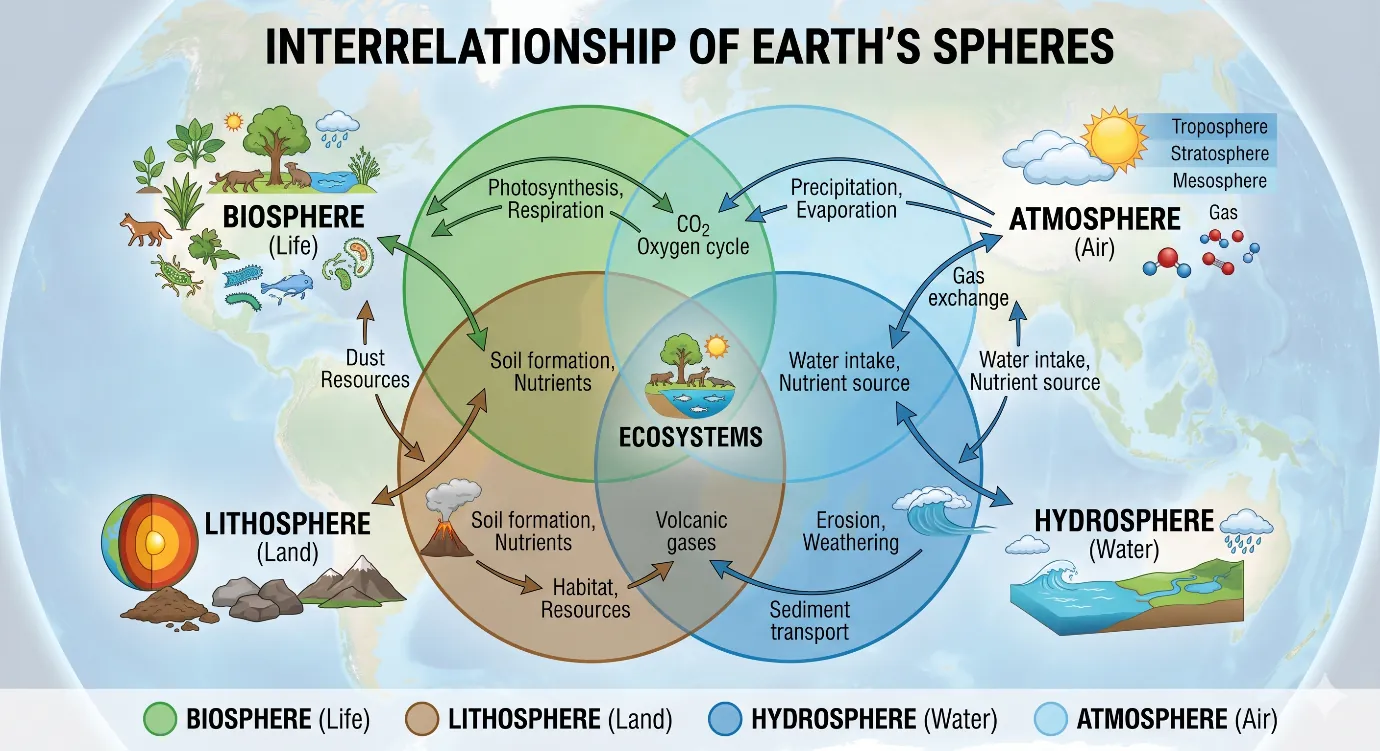
In a geological heartbeat, humanity constructed the Anthroposphere: the overarching domain of the planetary environment that is made, modified, or inhabited by humans. It encompasses all human activities, infrastructure, and cultures that interact with and shape Earth's natural systems—including cities, roads, sewage systems, farms, mines, factories, energy grids, computing networks, and communication channels. Crucially, the Anthroposphere incorporates our intangible and cultural constructs: laws, socio-economic models, software, blueprints, books, and folklore. In short, it is everything we do or have done.
Operating within the Anthroposphere as a vital sub-set is the Technosphere: the engine of physical technologies, hardware, machines, and industrial processes. It is the dynamic interaction between technology (the Technosphere) and sociology (our socioeconomic systems, laws, cultural norms, and economic incentives within the Anthroposphere) that actively drives all construction and modification across our built environment, agricultural systems, and land use practices.
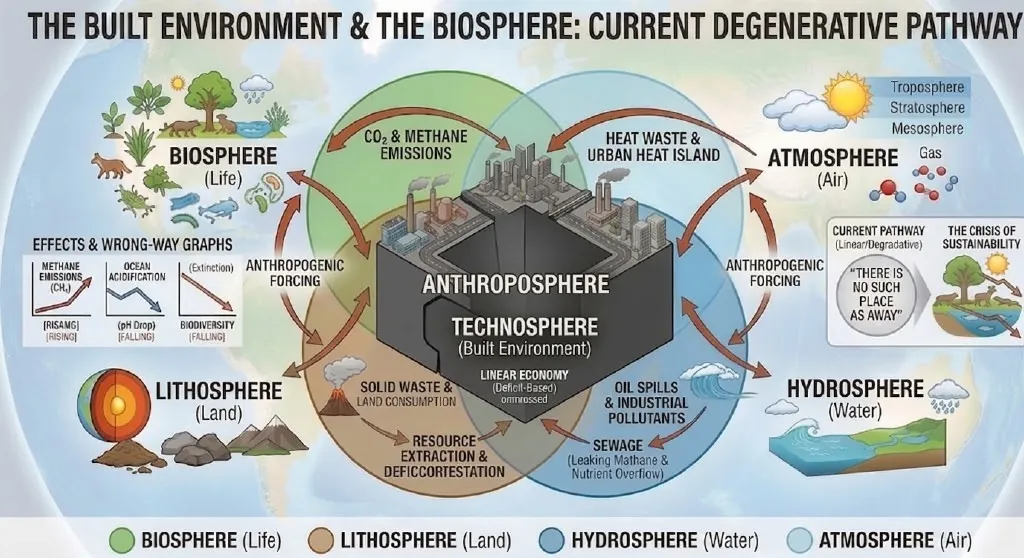
Regrettably, the modern Technosphere acts as a "Linear Deficit" engine running within the Anthroposphere. Driven by sociological demands and technological extraction, it consumes the Biosphere and Lithosphere, pollutes the Hydrosphere, and chokes the Atmosphere.
We are no longer merely confronting anthropogenic CO2 emissions; we are locked in a struggle for survival against runaway planetary feedback loops:
The Methane "Fuse": Ocean methane clathrates, thawing permafrost, and warming wetlands are releasing methane (CH4) at rates that accelerate warming independently of direct human input.
The Albedo Collapse and Ice Loss: The rapid loss of reflective Arctic sea ice, glaciers, and polar snow cover is causing a collapse in Earth's albedo. Dark, exposed oceans absorb hundreds of additional terawatts of solar heat, accelerating thermal expansion and ice melt.
Ocean Acidification: Massive absorption of excess CO2 by the oceans drops marine pH, disrupting calcification in shelled organisms and exoskeletal creatures (such as pteropods, mollusks, and corals) and pushing marine food webs toward collapse.
Biological Annihilation: We are causing the 6th Mass Extinction, with species vanishing 100 to 1,000 times faster than historical norms. A barren Earth stripped of biodiversity cannot provide the ecosystem services that sustain human civilisation.
Institutional Bottlenecks: Privatisation, Parkinson's Laws, and Productivity Collapse
The planetary crisis is exacerbated by systemic distortions within the sociological layer of the Anthroposphere, especifically our legal, political, and socio-economic institutions:
Privatisation of the Commons: Socio-economic models permit private entities to capture immediate profits from resource extraction and industrial processing, while externalising molecular waste, toxic effluents, and thermodynamic entropy onto the public commons.
Parkinson's Laws: As C. Northcote Parkinson observed, "work expands so as to fill the time available for its completion," accompanied by administrative expansion regardless of output. Applied to global ecology, international climate governance has degenerated into expanding administrative bodies, endless summits, and endless paperwork. While bureaucratic procedures proliferate, physical engineering solutions are stalled, choking the implementation of real interventions.
Real Productivity Decline: Financial metrics like GDP mask a dangerous physical reality: a severe collapse in real productivity (the net thermodynamic and biological return on human labour and resource input). As topsoil erodes, ocean chemistry destabilises, and extreme weather destroys capital assets, societies spend expanding resources merely repairing environmental damage. This leads directly to global economic stress and makes everyday survival increasingly difficult for ordinary citizens.
The Linear Pathway vs. The Regenerative Pathway
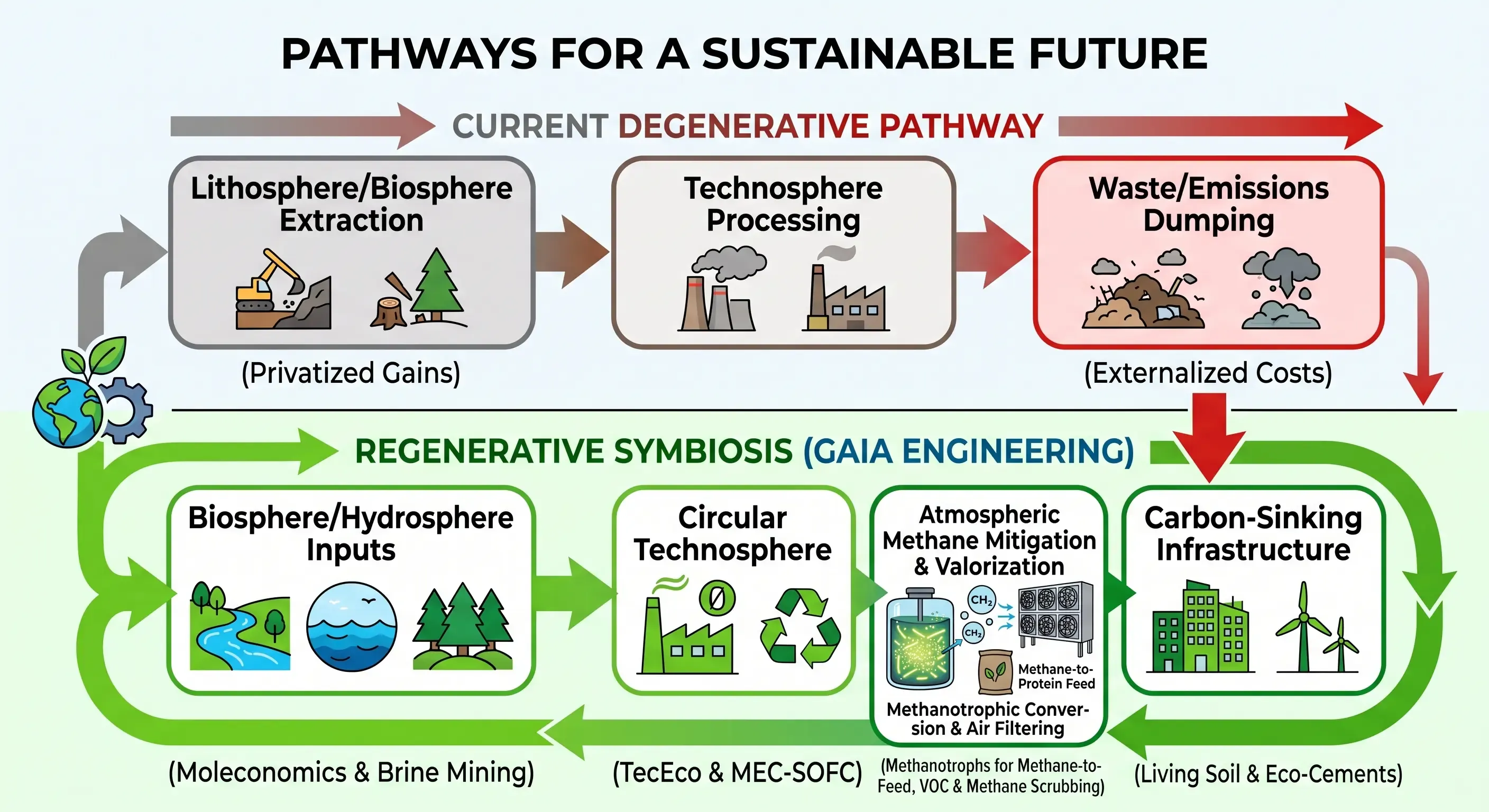
The linear deficit model treats the Earth as an infinite resource reservoir and a bottomless sink. "There is no such place as 'away'". Every molecule wasted represents an unpaid debt drawn against future generations.
The Evidence: The Graphs Are Going the Wrong Way
The physical data is clear. From vertical spikes in atmospheric methane to falling ocean pH, humanity is breaching planetary boundaries. Complete documentation of these empirical trends is detailed in the reference document Biosphere Sustainability Issues.
Marine ecosystems are failing as carbon absorption alters ocean chemistry, threatening shelled species and coral reefs essential to marine life. On land, destructive historical practices such as deep mechanical ploughing and flood irrigation without drainage—have degraded arable land and created man-made deserts across historically fertile regions.
Soil restoration is essential for planetary recovery. Carbon-rich, living soils hold significantly more moisture, support diverse microbial ecosystems, maintain natural fertility, and sequester large quantities of carbon. By replacing the plough with deep-mulch farming, proper subsoil drainage, and carbon-enriched amendments, we can reverse desertification and lock atmospheric carbon safely back into the earth.
The Solution: Gaia Engineering & Moleconomics
Gaia Engineering is the total redesign of the Technosphere and Anthroposphere to work in direct symbiosis with the Biosphere.
Rather than relying strictly on austerity or reduced consumption, Gaia Engineering applies Moleconomics: the profitable management, assembly, and tracking of molecules on a massive industrial scale. By understanding the chemistry and chemical scale, we can for example convert human settlements from carbon emitters into carbon sinks. There are many pathways and the papers on this site explore most of them.
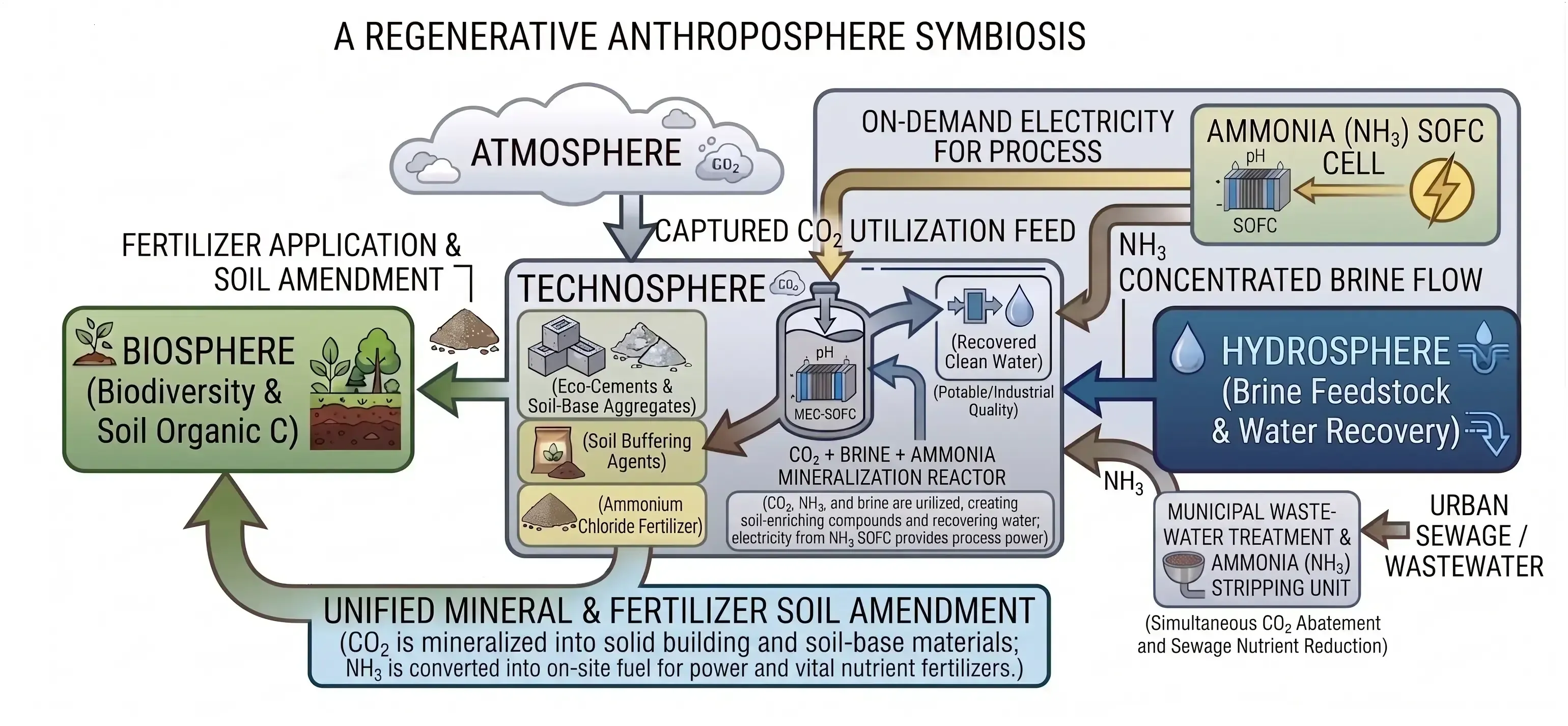
1. Cities as Carbon Sinks (TecEco Eco-Cements)
Construction can capture carbon rather than generating massive CO2 emissions. By integrating urban manufacturing with the world's 28,000+ desalination plants, we can mine calcium (Ca2+) and magnesium (Mg2+) cations from ocean brines—an abundant mineral source.
Combining these cations with captured industrial CO2 creates TecEco Eco-Cements and gas-permeable building materials. These eco-cements gain strength over time by "breathing in" atmospheric CO2. By balancing calcium and magnesium ion ratios, these materials eliminate structural shrinkage, display self-healing capabilities, and store carbon permanently. This process directly addresses ocean acidification and atmospheric carbon levels in a single industrial cycle.
2. The Energy Digestor (MEC-SOFC Loops)
We must replace waste disposal systems with circular resource harvesting. Globally, approximately 60,000 municipal sewage treatment plants can be upgraded into localized waste-to-energy hubs using Microbial Electrolysis Cell and Solid Oxide Fuel Cell (MEC-SOFC) systems.
These integrated digestors generate clean hydrogen (H2), supply local electrical power, and recover essential macro-nutrients (phosphorus, nitrogen, and potassium) into high-grade agricultural fertilizers. This eliminates nutrient runoff into waterways while providing localized, zero-carbon energy.
3. Restoring the Earth
By pairing urban carbon capture with regenerative agriculture, we can restore living soils. Ending deep tillage and applying carbon-enriched amendments re-establishes topsoil organic matter, restores watershed hydrology, and turns agricultural landscapes into long-term carbon sinks.
A Call to Action: Internalizing Externalities and Overcoming Gridlock
Technical innovations provide the machinery, but cultural, legal, and sociological restructuring within the Anthroposphere provide the motivation. To survive, humanity must transition from natural resource exploiters into active "Planetary Engineers" managing Spaceship Earth.
To succeed, we must cut through the bureaucratic paralysis outlined by Parkinson's Laws. Resolving planetary degradation requires direct engineering action rather than administrative expansion. Furthermore, socio-economic laws must internalise ecological costs: polluting the commons must carry financial penalties, while molecular carbon capture and nutrient recycling must be economically rewarded.
Explore the Roadmap
The physical evidence demands immediate action, and the engineering frameworks are established. Foundational research documentation are available on Gaiaengineering.org to the global community:
THE PERIL: [Biosphere Sustainability Issues] – A forensic audit of atmospheric trends, albedo loss, methane feedbacks, ocean acidification, and extinction rates using graphs.
THE RECOVERY: [Biosphere Sustainability Solutions] – A strategic roadmap for establishing a circular Technosphere, moleconomic tracking, and institutional reform.
THE ARCHITECTURE: [Solution Detail Papers] – Technical documentation on TecEco Eco-Cements, MEC-SOFC waste-to-energy systems, soil chemistry and many other topics are available free on Gaiaengineering.org.
While global environmental degradation is accelerating, chemical and physical principles offer a viable path forward. Re-engineering the Technosphere and reforming the Anthroposphere can allow us to preserve the Biosphere and prevent our own demise.
Learn more from tececo.org and gaiaengineering.org
References
From Tececo.org
Huxley, J. (1947) Evolutionary Humanism. London: Pilot Press.
Parkinson, C.N. (1957) Parkinson's Law, or The Pursuit of Progress. Boston: Houghton Mifflin.
Rockström, J., Steffen, W., Noone, K., Persson, Å., Chapin, F.S., Lambin, E.F., Lenton, T.M., Scheffer, M., Folke, C., Schellnhuber, H.J. and Nykvist, B. (2009) 'A safe operating space for humanity', Nature, 461(7263), pp. 472–475.
Teilhard de Chardin, P. (1959) The Phenomenon of Man. London: Collins.
Vernadsky, V.I. (1926) The Biosphere. Leningrad: Nauchnoe khimiko-technicheskoe izdatel'stvo.
Technical Papers & Conference Presentations on TecEco.org
Tececo Eco-Cement Masonry Product Update:
Detailed study by John Harrison exploring the exact carbonation chemistry, mineral formations (such as nesquehonite), and performance metrics of Eco-Cement bricks and pavers.
Carbonation and Waste Utilisation With Tec and Eco-Cements:
A conference paper mapping out the completion rates of atmospheric CO₂ reabsorption within porous masonry units.Low Carbon Cements and Concrete in Modern Construction: A comprehensive presentation evaluating the life-cycle analysis (LCA) of standard Portland cement compared to the low-embodied energy frameworks of magnesium-based binders.
TecEco Cements – A way forward for the Kyoto process?:
An article exploring early global implementation strategies and economic frameworks for massive-scale building material carbon sinks.
Product Brochures & Newsletters
TecEco Science Creating a Sustainable Future Brochure: A quick-reference technical product overview detailing the split formulations between Eco-Cements (50–75% MgO) and standard blends.
TecEco Newsletter Issue 19: An informational digest addressing the early phases of the Eco-Cement project and the integration of carbon-based fibres.
Further documents will be added time & money permitting.