
Solutions
John Harrison
Executive Summary
We live on “Spaceships Earth” and must be mindful of looking after it. Under the heading "Biosphere" on the Gaiaengineering.org website (https://gaiaengineering.org), I have or will be loading papers on the biosphere including interactions with the anthroposphere. Many of these papers present data on our planetary status and almost everything is trending in the wrong direction. I have summarized what is going on in our Problems page putting all the graphs in one place and briefly described what is going badly for the biosphere and why.
In this page on solutions I do my best to combine my knowledge of psychology, economics, science and the Biosphere to describe what is happening and offer some suggestion for changing our destiny.
We will have to change how we live to re-establish harmony with our rather unique blue – green planet.

Spaceship Earth
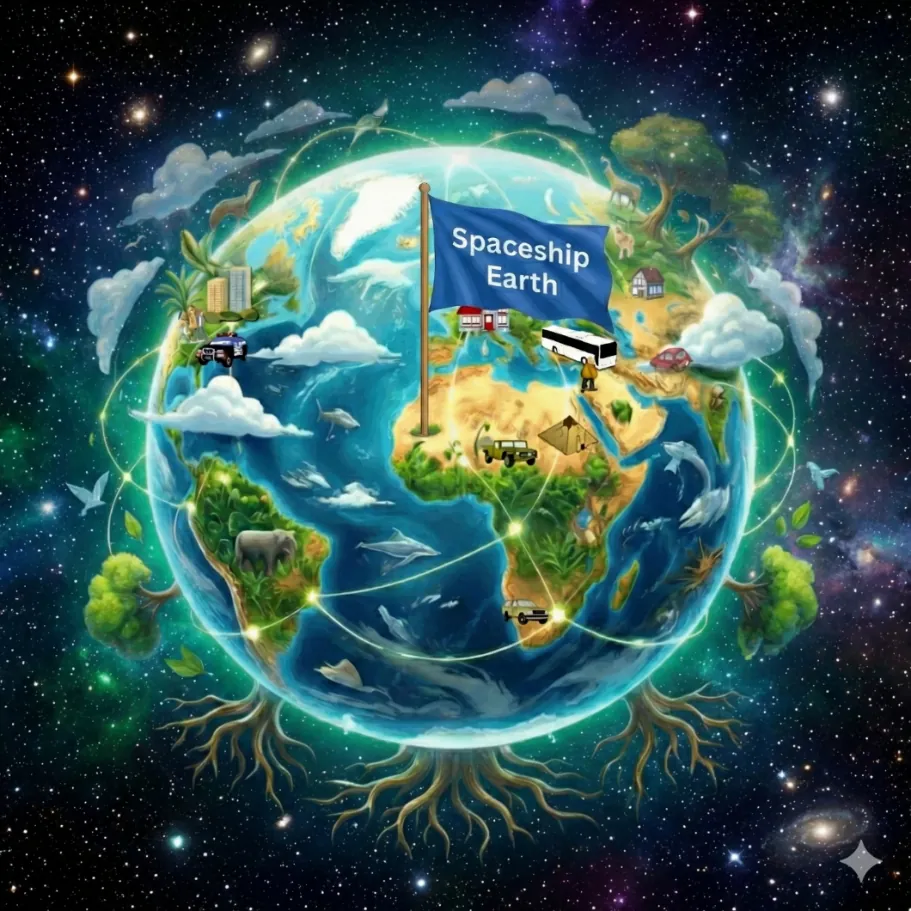 The
metaphor "Spaceship Earth" was first coined by economist
Kenneth E. Boulding in his 1966 essay The Economics of the Coming
Spaceship Earth and later popularized by Buckminster Fuller in
his 1969 book Operating Manual for Spaceship Earth. The
concept frames Earth as a closed system with finite resources,
reminding us that humanity must act as responsible crew members.
Keeping the biosphere stable and productive is about balance as our
planet’s biosphere operates as a closed system.
The
metaphor "Spaceship Earth" was first coined by economist
Kenneth E. Boulding in his 1966 essay The Economics of the Coming
Spaceship Earth and later popularized by Buckminster Fuller in
his 1969 book Operating Manual for Spaceship Earth. The
concept frames Earth as a closed system with finite resources,
reminding us that humanity must act as responsible crew members.
Keeping the biosphere stable and productive is about balance as our
planet’s biosphere operates as a closed system.
Despite three to four decades of expanding knowledge, greenhouse gas emissions have soared, biodiversity loss has accelerated, and many other planetary boundaries are being breached . The metaphor of Spaceship Earth was not just poetic; it was a call for action to guide our biosphere back to balance the Technosphere which is our built environment. See my paper on Spaceship Earth under biosphere on the Gaiaengineering.org web site.
The Way Forward
There are Biosphere Sustainability Solutions that we must discover or learn more about, understand and do something about if we want to save our biosphere and survive. Some of them that I outline in this paper will make a considerable difference.
The first thing that must happen is for enough of us to become aware of the earth’s sustainability problems and their solutions that is why I have been busy writing papers to sell at peppercorn prices on the Gaiaengineering.org website (https:// Gaiaengineering.org).
Biosphere issues in the past have been very much an externality. That is why the united nations and governments have substantially failed so far to improve the status quo.
People on mass must want to take ownership of our biospheres sustainability issues and do something about them.
This can happen if:
People learn about it through word of mouth or in the media
Schools and Universities include the biosphere in their curricula.
Our TV and radio continue to offer free programs about nature and its wonders (Thank you Sir David Attenborough. I am proud of you and hope I live as long as you because I have a lot of work to do. John Harrison)
Religions teach about the biosphere and mandate action.
We progress toward circularising our economies
New resource efficient technologies must continue to evolve covering:
Diets and foods requiring less land and with lower impacts
How we get about
How we deal with our wastes
Building with carbon
Building greener cities
How we can incorporate nature more in our lives
The United Nations continues to provide and steps up accessible guidance to people, not just closeted environment ministers.
Governments around the world prioritize the problem
Read on as there is much more I have to say!
Communities establish local sustainability groups that take practical action (e.g., revegetation, circular economy hubs, waste‑to‑resource initiatives).
Local councils actively support neighbourhood-scale sustainability programs and nature restoration projects.
Businesses adopt transparent sustainability reporting and voluntarily exceed minimum regulatory requirements.
Large corporations phase out harmful practices and adopt circular economy models because consumers demand it.
Banks and financial institutions redirect capital away from destructive industries and towards regenerative ones.
Media organisations consistently highlight both environmental problems and solutions so the public can see a viable path forward.
Influencers, celebrities, and public figures normalise sustainable behaviour through their platforms.
Scientific organisations communicate research in plain language so the average person can understand the stakes and the opportunities.
Indigenous knowledge systems are recognised, respected, and integrated into land management, water stewardship, fire management, and biodiversity protection.
Governments remove perverse subsidies that incentivise environmental damage.
Citizens demand accountability from elected representatives through voting, petitions, and peaceful activism.
Consumers increasingly choose low‑impact products, forcing markets to adapt through demand pressure.
Labelling standards clearly communicate the true ecological footprint of products.
Urban planning prioritises walkability, public transport, green spaces, and biophilic design.
Technology companies innovate with tools that track personal or community ecological impact, helping people make informed decisions.
International trade agreements include enforceable environmental obligations.
Disaster preparedness and climate adaptation become mainstream knowledge, encouraging proactive rather than reactive behaviour.
Philanthropic foundations fund large-scale biodiversity, climate, and ecosystem restoration projects.
Cultural creators (film, music, books) incorporate environmental themes that motivate collective responsibility.
On driving mass ownership of biosphere sustainability, here are several high-impact points focusing on economics, legal frameworks, and cultural shifts:
Financial Incentives and Disincentives: Shifting the "default" choice by making sustainable products the most affordable option through subsidies, while taxing high-impact practices.
The Circular Economy: Moving away from "take-make-waste" models to systems where every product is designed to be disassembled and reused, making waste a Legal Rights for Nature: Granting legal personhood to vital ecosystems (like rivers or forests), allowing them to be represented in court to protect against degradation.
True Cost Accounting: Mandating that the market price of goods includes their environmental "externalities" (carbon footprint, water use, habitat loss), so the biosphere is no longer a free resource for industry.
Workplace Integration: Corporations move beyond "greenwashing" to embed sustainability into their core KPIs, where employee bonuses and company success are tied to ecological restoration targets.
Cultural Redefinition of "The Good Life": Using art, film, and social media to shift the global status symbol from "conspicuous consumption" to "minimalist stewardship" and community-wellbeing.
Urban Rewilding and Biophilic Design: Integrating functional ecosystems into every streetscape so that nature is an everyday physical reality for urban populations, not a distant holiday destination.
Open-Source Environmental Data: Providing citizens with real-time, neighborhood-level data on air quality, biodiversity health, and water purity to foster local accountability.
Gamification of Action: Developing platforms that reward sustainable behaviors with social or financial capital, turning biosphere protection into a collective, engaging challenge.
Who are the greatest nature promoters of all time ?
Sir David Attenborough
The most influential nature communicator in human history and the most frequently mentioned globally due to his 70-year career and peerless reach. However, if we look at different "types" of promotion, high-energy entertainment
Seven decades of documentaries that brought the natural world into billions of homes
Raised global awareness of climate change, biodiversity loss, and ecological fragility
Inspired countless scientists, conservationists, and policymakers
Humanised nature with storytelling accessible to all ages and cultures
Rachel Carson
The woman who launched the modern environmental movement.
Author of Silent Spring (1962)
Exposed the dangers of pesticides like DDT
Triggered policy reform in the U.S. and around the world
Led directly to the creation of the EPA and the banning of DDT
Demonstrated that science-based environmental warning can galvanise public action
Janine Benyus
Global champion of biomimicry designing human systems inspired by nature.
Popularised the concept of biomimicry
Showed how ecosystems can inspire architecture, energy systems, materials, and product design
Her work shifted industry thinking toward regenerative, rather than extractive, solutions
Established Biomimicry 3.8, influencing companies and governments globally
Jane Goodall
Brought compassion and scientific understanding to animal behaviour and conservation.
Transformed our understanding of chimpanzees and primates
Humanised wildlife through storytelling
Built the global Roots & Shoots movement to empower young conservationists
A lifelong ambassador for forests, wildlife, and coexistence
E.O. Wilson
“Darwin’s natural heir” and the champion of biodiversity.
Coined major concepts such as biophilia and half‑earth conservation
Pioneered modern biodiversity science
Pushed governments and scientists toward large-scale conservation strategies
Sylvia Earle
The leading voice for ocean conservation.
Legendary marine biologist
Advocate for marine protected areas
Her “Mission Blue” campaign protects oceans worldwide
Showed the public the beauty and fragility of marine ecosystems
David Suzuki
Brought environmental science to mainstream television.
Hosted The Nature of Things
Made ecology, climate science, and sustainability understandable to millions
Long-time advocate for indigenous ecological knowledge
Wangari Maathai
Nobel Peace Prize winner who connected ecology with human rights.
Founded the Green Belt Movement
Planted over 51 million trees across Kenya
Promoted women's empowerment through ecological restoration
Carl Sagan
Expanded environmental awareness beyond Earth.
Explained the fragility of the biosphere using planetary science
The “Pale Blue Dot” message reshaped global ecological consciousness
Popularised science in ways that encouraged stewardship of Earth
Sir David Attenborough is, scientific advocacy, or pioneering activism, several others are in the top tier.
Here are the winners of nature promoters in my view:
1. The Voice of the World: Sir David Attenborough
I have already mentioned him, and for good reason. No other person has narrated the story of life on Earth for as many people over as many decades.
The Impact: He transitioned from showing "nature as a spectacle" to "nature as a crisis." His later work, like Blue Planet II and A Life on Our Planet, directly triggered massive global policy shifts on plastic waste and carbon emissions.
2. The Force of Personality: Steve Irwin
If Attenborough is the professor, Steve Irwin was the "action hero."
The Impact: He reached a demographic that documentaries often missed: children and those who found traditional nature programs too slow. His "Crocodile Hunter" persona turned "scary" animals (crocodiles, snakes, spiders) into creatures worthy of love and protection. He used his fame to buy vast tracts of land for conservation, a legacy his family continues.
3. The Ethical Pioneer: Dr. Jane Goodall
Goodall redefined what it means to "promote" nature by blurring the line between humans and animals.
The Impact: By naming the chimpanzees she studied (rather than numbering them), she forced the world to recognize animal sentience. Her Roots & Shoots program has turned millions of young people into active conservationists across 100+ countries.
4. The Undersea Explorer: Jacques Cousteau
Before Attenborough was a household name, Cousteau was the world’s window into the "Silent World" of the oceans.
The Impact: He co-invented the Aqua-Lung (SCUBA), which literally allowed humans to see the 70% of the planet that was previously hidden. His films won three Oscars and a Palme d'Or, making marine conservation a mainstream global priority for the first time.
5. The Catalyst: Rachel Carson
While less of a "media personality" in the modern sense, she is often credited with saving the biosphere from chemical collapse.
The Impact: Her book Silent Spring (1962) was the first time the public was shown that human "progress" (like DDT) was killing the natural world. It led to the creation of the US Environmental Protection Agency (EPA) and is the foundation of the modern environmental movement.
John Muir: The "Father of the National Parks," whose writing convinced the US government to protect places like Yosemite.
Greta Thunberg: For mobilizing the youngest generation into a political force through mass protest.
Al Gore: For using high-level political influence and data visualization to make climate change a global talking point.
I am John Harrison and I should tell you about my library
I have the following texts from early environment writers.
David Suzuki and Holly Dressel. Good News for a Change. Hope for a Troubled Planet
Eugen Linden. The Future in Plain Sight
Eugen Linden. The Winds of Change.
Mayer Hillman. How We Can Save the Planet
Rory Spowers. Rising Tides. A History of the Environmental Revolution and Visions for an Ecological Age.
Janine M Benyus. Biomimicry. Innovation Inspired by Nature
Rachel Carson. With essays by Edward O. Wilson and Linda Lear. Silent Spring
James Lovelock. The Ages of Gaia
James Lovelock. A New Look at Life on Earth
Ron Nielson. The Little Green Handbook
Al Gore. An Inconvenient Truth. The Planetary Emergency of Global Warming and What we can do about it.
Al Gore. Our choice
John Ralston Saul. Voltaire’s Bastards. The Dictatorship of Reason in the West
Lester R Brown. Plan B3.0. Mobilising to Save Civilisation
Peter Ellyard. ideas for the new millenium
Paul Weaver, Leo Jansen, Geert van Grootveld, Egbert van Spiegel, Phillip Vergragt
Jared Diamond. Guns, germs and steel. A short history of everybody for the last 13,000 years.
Jarred Diamond. Collapse. How Societies Choose to Fail or Survive. He also wrote about Easter Island.
Professor Robert M. Carter. Climate: The Counter Consensus. Preparatory Essay by Tom Stacey.
Don Tapscott and Anthony D. Williams. Wikinomics How Mass Collaboration Changes Everything.
Tim Flannery. The Weather Makers. The History and Future Impact of Climate Change
Tim Flannery. We are the Weather Makers. The Story of Global Warming.
William F. Ruddiman. How Humans Took Control of Climate.
William L Burroughs. Climate Change in Prehistory. The End of the Reign of Chaos
William McDonough – architect and design theorist and Michael Braungart – chemist and materials scientist. Cradle to Cradle: Remaking the Way We Make Things
Malcolm Gladwell, The Tipping Point. How Little Things can Make a Big Difference
Jay Harman. The Shark’s Paintbrush
Helen Cushing. Beyond Organics, Gardening for the Future.
Paul Hawken, Amory B Lovins, L Hunter Lovins. Natural Capitalism The Next Industrial revolution.
Paul Hawken. The Ecology of Commerce
Dan Gardner. Future Babble
Oliver Milman. The Insect Crisis
Mathew Evans. Soil
Peter Singer, One world. The ethics of globalisation
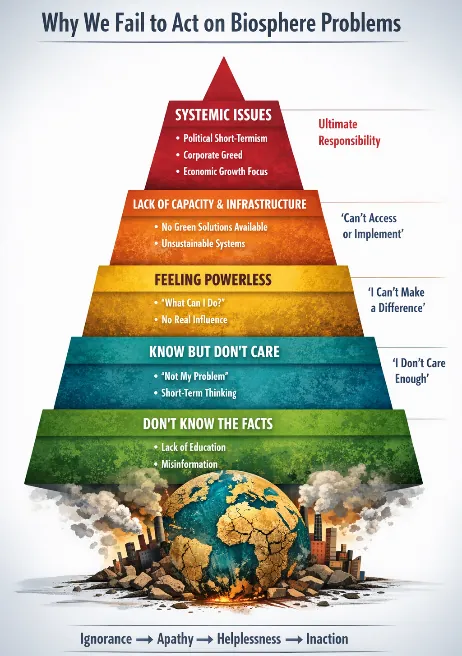
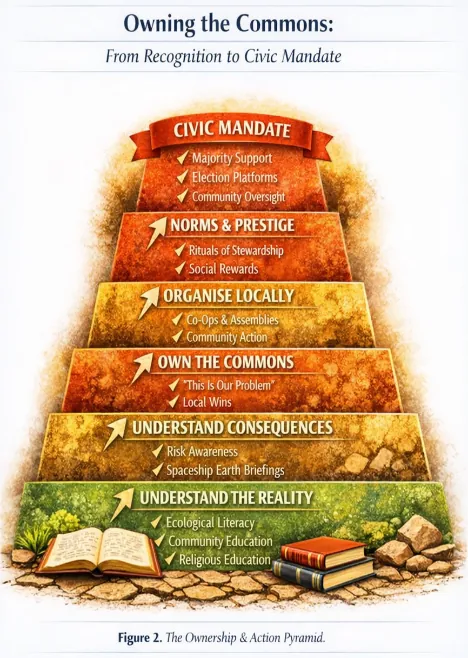
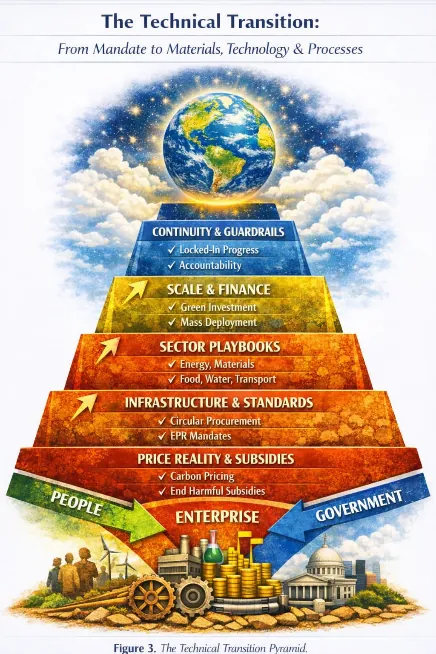
If enough people personally feel the need and care then take heart, there is a lot we can do to reduce our impact on spaceship earth! I have prepared some posters on the following three pages. Please feel free to use them. Just mention where you got them from and promote others to use them.
The History of Hurdles to Overcome
The history of international environmental governance is a graveyard of unmet goals. In 2010, the world agreed to the Aichi Biodiversity Targets, a "strategic plan" to halt the collapse of the natural world. By 2020, the United Nations reported that not even one of the twenty targets had been fully met (CBD, 2020). Today, the Kunming-Montreal Global Biodiversity Framework (GBF) attempts to succeed where Aichi failed, most notably with the "30x30" target to conserve 30% of the planet by 2030. Yet, despite stricter metrics and bolder ambition, the GBF faces the same structural peril as its predecessor: it remains a "top-down" imposition on a reality that requires "bottom-up" participation. Few people even heard of Aichi or the Kunming Montreal GBF let alone what it involved. This is the hurdle to overcome.
Care must come from the bottom up. The people must care and caring comes through knowledge that comes from secular and religious education and results in ownership that initiates action. Action that is more effective than in the past.
The root of this failure is not merely bureaucratic; it is a fundamental misalignment with human nature regarding shared resources. To understand why global targets have in the past and may continue to fail, I will trace the intellectual history of the "commons" from Aristotle’s ancient warnings and Lloyd’s Logic to Garrett Hardin’s fatalism, Elinor Ostrom’s empiricism and finally Hume’s Guillotine.
If the scale of internalisation is expanded from the bottom up there may be a solution beyond economics or policy. If the survival of the biosphere requires collective action, humanity must transition from passive inhabitants of a global commons to active owners and stewards. I believe that education at schools, universities and in churches is an important driver mechanism for this transition and probably the main tool capable of converting the "commons" from an abstract global concern into an internalised personal ethical responsibility or in Hume’s language converting an Is to what Ought to be.
Before we can change what is a systems problem people must understand ecological reality, community needs, and their moral/ethical responsibility.
Aristotle and the Dilution of Care
The dilemma of the commons was identified more than two millennia before the invention of the steam engine. In his critique of Plato’s Republic, Aristotle argued against the communal ownership of property, identifying a psychological axiom that remains relevant to modern conservation:
"That which is common to the greatest number has the least care bestowed upon it. Every one thinks chiefly of his own, hardly at all of the common interest; and only when he is himself concerned as an individual." (Aristotle, 1885, p. 32).
Aristotle’s insight in Politics (Book II, Chapter 3) was not that humans are inherently malicious, but that care is a finite resource that dilutes with scale. When a duty is shared by all, it is felt by none.
The mathematical concept of the commons was first enunciated by the British economist William Forster Lloyd.
The Context: He observed the shared grazing lands (the "common") in English villages.
The Logic: He argued that if a single herder adds one extra cow to a shared field, they gain the full benefit of that cow, while the "cost" (overgrazing) is shared by everyone.
The Shift: Lloyd moved the problem from an observation of nature to a mathematical proof of individual vs. collective rationality.
The global atmosphere and the open ocean are the ultimate commons: vital to all, owned by none, and neglected by most.
The Modern Trap: Hardin’s Tragedy
In 1968, the ecologist Garrett Hardin formalised Lloyd’s observation into a darker theory: In his essay "Tragedy of the Commons" published by Science, he used a similar metaphor of a pasture open to all herdsmen. Hardin used the word Tragedy in the dramatic, Aristotelian sense, not as a "sad event," but as a remorseless working of things. He argued that in a world of finite resources, individuals acting independently and rationally according to their own self-interest will eventually deplete the resource, even if it is not in anyone's long-term interest. He argued that individual rationality inevitably leads to collective ruin. A herdsman who adds an extra animal receives +1 unit of benefit, while the cost (overgrazing) is fractionally distributed among all users. The "rational" conclusion is to exploit the resource until it collapses.
Hardin’s conclusion was stark: "Freedom in a commons brings ruin to all" (Hardin, 1968, p. 1244). He believed that appeals to conscience were futile and that the only solutions were "mutual coercion" (strict government regulation) or privatisation. The Aichi Targets and the the Kunming-Montreal Global Biodiversity Framework (the GBF) essentially operate on Hardin’s "mutual coercion" model. They were an attempt to impose top-down regulatory limits on nations. However, without an enforcement mechanism or a global sovereign, this "coercion" is toothless. The "tragedy" continues because the participants do not feel the immediate cost of their exploitation. Continuing with Lloyd and Hardin’s reasoning on the commons and using the term I will show later in this paper that “owning” or “internalising” the problems of the commons in a broader sense is the way forward.
The Ostrom Turn: Polycentricity and "Owning" or “internalising” the Problem
The narrative of inevitable doom was challenged by Elinor Ostrom, whose Nobel Prize-winning work demonstrated that the tragedy is not destiny. Through the study of irrigation systems in Spain, forests in Japan, and fisheries in Turkey, Ostrom (1990) proved that communities can manage shared resources sustainably by owning or internalising the commons through social norms rather than just taxes or fences
Crucially, Ostrom found that successful governance was never purely top down. It relied on what she called Polycentric Governance nested systems where decision-making authority is distributed (Ostrom, 2010). The most sustainable systems were those where the users themselves had a voice in creating the rules. They succeeded because the "commons" was not an abstraction; it was a local reality that they understood, monitored, and depended upon.
This understanding highlights the fatal flaw of the global top down agreements like Aichi and Kunming-Montreal. The targets were designed by diplomats in Nagoya, far removed from the farmers in Brazil or the fishermen in Indonesia who were expected to implement them. There was no "collective-choice arrangement" (Ostrom, 1990).
The people did not "own" the problem or the rules, so they have little incentive to follow them.
Bridging "Is" to "Ought" (Hume’s Guillotine)
According to Hume, knowing about something “is”. Feeling that you ought to do something about it because of your values, passions and beliefs is an ought, an ethical internalisation or taking ownership. Hume’s way of putting it is known as crossing the Is-Ought Gap (David Hume). It will get us to the same place as “internalisation” or ownership of the problems we face.
The "Is" (Hardin/Lloyd) |
The "Ought" |
Observation: People are selfishly depleting the common resource because they don't pay the full price. |
Prescription: People ought to own the problem as a matter of character and virtue. |
Mechanism: External pressure (Fines, fences, police). |
Mechanism: Internal habituation (Aristotelian "Hexis"). |
Result: Compliance through fear of loss. |
Result: Stewardship through the pursuit of excellence. |
The Aichi Legacy: Ambition Without Action
The Aichi Biodiversity Targets failed primarily because they lacked quantitative metrics and a robust mechanism for accountability. According to the Global Biodiversity Outlook 5 (CBD 2020), none of the 20 targets were fully met by the 2020 deadline. This failure is often attributed to "aspirational" language that allowed governments to report progress without meaningful change. Furthermore, the targets were plagued by a lack of integration into national economic planning; biodiversity remained a "siloed" environmental issue rather than a core component of development, leading to a continued surge in habitat loss and unsustainable subsidies (Almond, Grooten and Petersen 2020).
The Aichi targets failed because they stayed in the "Is" phase they identified the problem (biodiversity loss) but failed to create "Internalisation" or conviction for “ought” economically or ethically. Countries saw the "Commons" (the Earth’s biosphere) as something they could exploit while others paid the price for conservation.
Hardin would say they lacked "Mutual Coercion"; I say not enough people owned the problem, it was not internalised by them and not enough people at the time felt they ought to do anything.
Kunming-Montreal: A Repeat of History?
While the Kunming-Montreal GBF, adopted in 2022, introduced more specific "30x30" goals (protecting 30% of land and sea by 2030), it faces a high risk of failure due to financing and monitoring gaps. Current projections suggest a biodiversity finance gap of approximately $700 billion per year (Barbier 2023). Critics argue that without a drastic shift in how developed nations provide "new and additional" financial resources to the Global South, the framework will suffer the same fate as Aichi. Additionally, the voluntary nature of National Biodiversity Strategies and Action Plans (NBSAPs) means that unless there is a significant increase in political will and corporate transparency, the drivers of nature loss—such as industrial agriculture and mining will continue to outpace conservation efforts (Obura et al. 2021).
Drivers for Change
For society to move fast enough to protect our future, we need a self-reinforcing cycle of change that runs on its own once started and rapidly becomes the way most of us think. This section explains how that engine could work.
If many people knowing and “owning” the truth, move to changing what we value and shift their daily choices, we can create a world where protecting nature is just "the way things ought to be done." Other primates act as the primary "groundskeepers" of tropical rainforests. Their survival activities ranging from the mechanical deworming of their own bodies to educating their young about tool use directly facilitate carbon sequestration and forest regeneration. (Indiana University Blogs, 2019). Perhaps we could learn from them?
We can learn new behaviours just like other primates. See my paper The Primate Architect.
The first step and most important is for large numbers of people to see and understand the Big Picture. Everything begins with seeing reality clearly. For a long time, the destruction of nature felt distant. We need to feel for nature more than we do. I love nature and think it good for us.
The spark for change is education, but not just the kind found in classrooms or church annexes. It is the realization shared by scientists, teachers, students and neighbours that a stable planet is not a "nice-to-have" luxury; it is the foundation of our safety, everything we need. When we understand that clean air, reliable rain, and healthy soil are the only things keeping our supermarket shelves stocked and our homes safe, the environment stops being a political issue and becomes a personal one. We must “own” and internalise the commons. We “ought” to feel we should.
Internalisation and the Commons
Environmental economists use the term Internalisation in a purely economic sense to describe policies that force market systems to reduce ecological harm.
Examples of Economic Internalisation:
Pigouvian taxes (e.g., a Carbon Tax) or "Cap and Trade" force markets to reflect the true ecological cost.
Extended Producer Responsibility (EPR): manufacturers responsible for end-of-life recycling.
Water extraction charges: users pay based on actual ecosystem pressure.
Polluter Pays Principle (PPP): costs are borne by those who cause the damage.
When these costs are internalised, markets behave more sustainably, because destroying the commons becomes economically irrational.
Although I am a trained economist I think we should also infuse the term “internalisation” with Aristotelian virtue ethics and pragmatism.
In the Aristotelian sense, ethics is the harmony of Logos (reason/philosophy) and Pathos (emotion/feeling) through Ethos (character).
Feature |
Emotive |
Philosophical |
Ethics |
Source |
Feeling / Compassion |
Logic / Worldview |
Virtue / Habituation |
Action |
Reactive (responding to harm) |
Proactive (structural duty) |
Integrated (Living well) |
Focus |
The "Heart" |
The "Mind" |
The "Character" |
The comment that "We are what we repeatedly do. Excellence, then, is not an act, but a habit." is commonly attributed to Aristotle (summarizing Nicomachean Ethics)
By internalising the problems of the biosphere into our character, we aren't just "feeling" the “ought” about doing something about the environment or "thinking" about it; we are embodying the solution into our ethics.
Field |
Core Concept |
The Aristotelian Link |
Psychology |
Assimilating a value into the self. |
Character/Virtue: The "Ought" becomes a habit (Hexis). |
Economics |
Accounting for external costs. |
Coercion: The "Is" of the market is forced to pay for harm. |
Sociology |
Acceptance of social norms as one's own. |
The Commons: Moving from "Least care" to "Shared |
The term “commons” refers to shared natural systems such as:
Air, fresh water, the oceans, fisheries, soil, forests and the climate system
Because no single actor "owns" these resources, individuals and companies tend to overuse them and under-invest in their protection
Internalisation solves this by:
Embedding environmental stewardship in law, policy, and culture.
Ensuring actors pay for the real costs (pollution, extraction, ecological damage).
Encouraging long-term thinking rather than short-term exploitation.
Redefining What We Need
Once we truly understand how much our lives depend on nature, our priorities shift naturally. We don't need a textbook on psychology to understand this; we feel it, when we have internalised it we feel better about it.
Safety: We realize that a stable climate is as essential as a lock on the front door.
Belonging: We start to admire neighbours who care for the community, rather than just those who have the most stuff.
Purpose: We find satisfaction in fixing, growing, and protecting things, rather than just buying and discarding them.
This isn't about sacrifice. It’s about realizing that what we thought we needed (more disposable stuff) doesn't make us safe or happy, but a healthy world does. We ought to do something about keeping it healthy. We should share the commons.
Economists have not only restricted what they mean by internalisation, they also have a complicated way of saying that people do what makes them feel good (Maslow’s needs theory). Put in simple terms, we "vote" with our time and money every day based on what we value.
As our understanding changes, the "price tag" of our choices changes in our minds:
The High Cost of Waste: Buying a cheap, disposable item starts to feel "expensive" because we know the cost to the planet (and our future) is too high.
The Value of Care: Repairing an old item or buying local food starts to feel "richer" because it connects us to our community and aligns with our values.
We “ought” to start chasing a different kind of wealth, the wealth of clean rivers, healthy kids, and a stable future. We can move from being Consumers (who just use things up) to Contributors (who build things up).
The zeitgeist (pronounced tsait-gaist) is a German loanword that literally translates to "spirit of the times."
It refers to the invisible force that defines the cultural, intellectual, and moral climate of a specific era.
During the industrial revolution the zeitgeist focussed on mechanisation and progress, in America until recently on upward mobility and growth, luxury goods and large homes. It needs to change to recognise the reality of our relationship with the biosphere. We are living through a period where the "Is" of our industrial and economic success has directly collided with the "Is" of biological collapse. To survive, the Zeitgeist must pivot from a philosophy of extraction to a philosophy of reciprocity.
We tend to take good care of what we own personally, but we neglect what we share such as the air, the oceans, and the climate. Very few people "own" the biosphere issue, they are not taught about it in church or schools, and many do not believe what they see and hear about its gradual demise. Our planets commons have for far too long been treated without reverence and more like a free dumping ground.
Individual action alone cannot solve our sustainability issues. One person refusing to pollute doesn't save the biosphere if millions of others still do. This is where the weight of numbers becomes essential.
Moving the weight of Opinion
When a critical mass of ordinary people shifts their values, "sacrifice" turns into "power." We stop being scattered individuals trying to be good and become a united force that demands care for our shared home. This "weight" is the tipping point. It is the moment when protecting the commons stops being a charitable hobby and becomes a non-negotiable demand of the majority, the zeitgeist of nations, of the world.
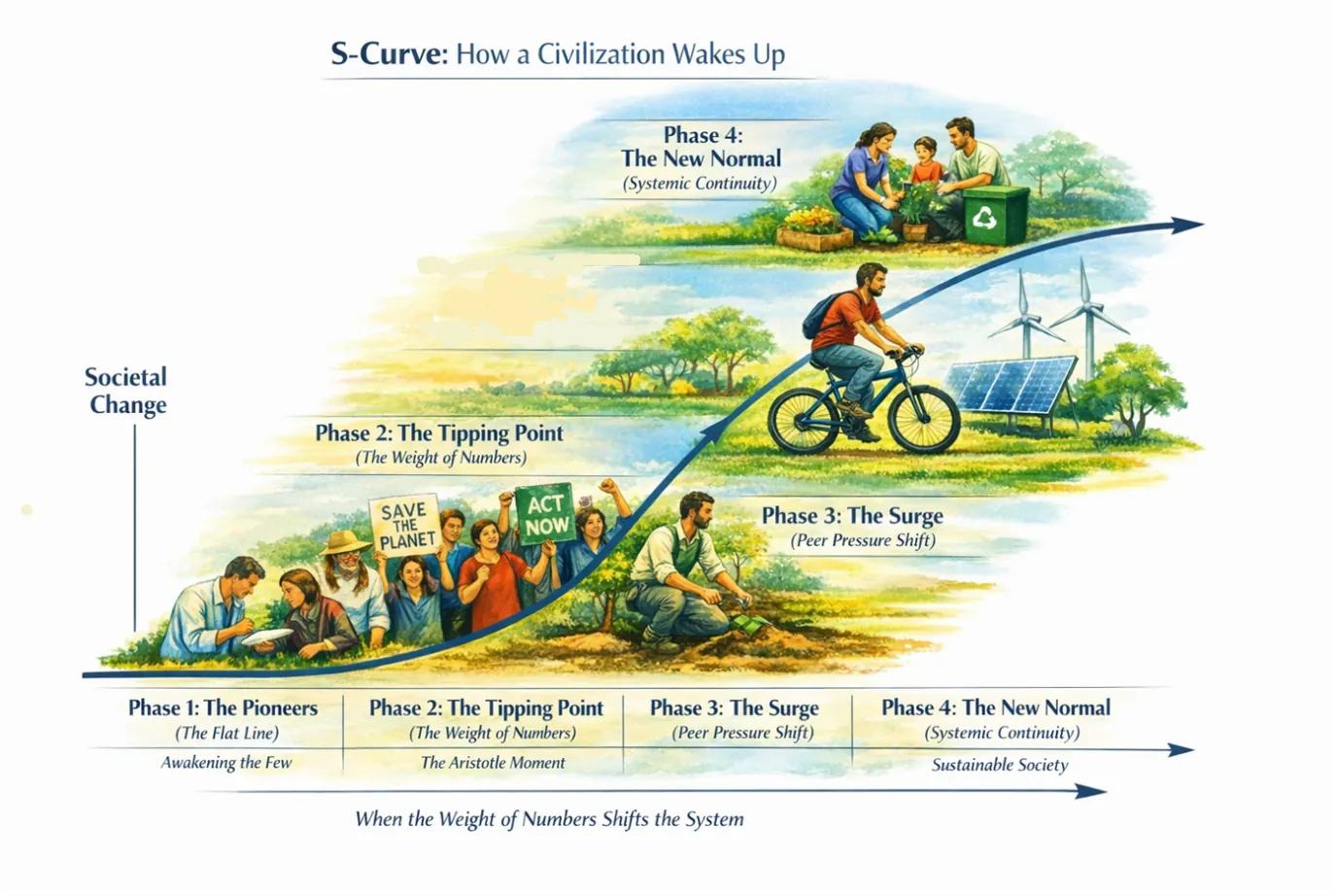
Given the urgency of our situation, I will visualize how this shift could happen. It is not a straight line; it is an explosion of change known as an S-Curve.
Phase 1: The Pioneers (The Flat Line). A small group of educators, scientists, and stewards like me struggle to wake people up. Progress feels slow.
Phase 2: The Tipping Point (The Weight of Numbers). The moment where new values reach 10-25% of the population.
Phase 3: The Surge (The Vertical Climb). The "Self-Reinforcing Loop" kicks in. Peer pressure works for the planet. It becomes socially awkward not to care.
Phase 4: The New Normal (Systemic Continuity). Sustainability is no longer a "cause" it is just how the world works. Finally the majority realize the Commons must be protected and the system protects the biosphere automatically.
 When
the "Weight of Numbers" is high enough, we stop accepting a
system that cheats.
When
the "Weight of Numbers" is high enough, we stop accepting a
system that cheats.
Currently, many companies pollute for free, leaving the rest of us to pay the price in health costs and cleanup. This is like a factory dumping trash in your backyard to save money on garbage collection. It’s not "efficient"; it’s theft. It’s happened to me. Let me explain. I lived for years on a small hobby farm near Hobart, Tasmania. People regularly dumped rubbish over the fence on my property. When I found a letter identifying the culprit I dumped it in their front door. They were admonished!
By demanding that prices reflect the true cost of pollution, we aren't just punishing bad behaviour; we are making sustainable behaviour the easy, default choice.
Real Prices: If a product destroys a rainforest, it should cost more than one that protects it.
Real Rules: Waste becomes expensive, and durability becomes cheap.
The Loop Closes once we fix the rules to match reality and we don't need to rely on willpower anymore. Buying the green option becomes the cheaper option. Living sustainably becomes the normal way of life and governments prioritise the problem.
This is the self-reinforcing loop. Awareness creates new values. New values demand fair rules. Fair rules make sustainability the path of least resistance. And once the wheel starts turning, it will gather the speed we need to secure our future.
Internalisation is enabled as a result of Education
If Ostrom’s solution relies on community members who understand and monitor their resources, how do we scale this to the planetary level? The biosphere is a global common, too vast for any single village to monitor. The important bridge between the global crisis and local action is education.
For the GBF to succeed where Aichi failed and other top-down approaches will probably also fail, the "commons" must be internalised by people en masse. We must artificially recreate the intimacy of Ostrom’s village on a global scale. This is the function of education: to make the invisible visible, and to transform the external environment into an internal value backed by the knowledge of it. Education is essential. The more people who are educated the less they will breed and more they will understand issues affecting them. The more they will own or internalise the massive problems we face.
Education at Schools and Universities
Many people in some countries do not have any education at all. Especially women who have too many children forced upon them from a young age. Education is very important even if current educational models largely treat the environment as a distinct subject, biology or geography for example are detached from the economic and social self. To solve the Aristotelian problem of neglect, education would be better if we included Ecological Education that integrates the biosphere into every aspect of learning. This does not mean simply teaching the facts of photosynthesis; it means cultivating an "ecological literacy" (Orr, 1992) where the student understands that their wellbeing and survival is contingent on the biosphere and this helps internalise its problems
We can no longer afford to neglect that which is common to the greatest number. We must be very aware that if we do not fix the problems of the biosphere we will not survive. Danger brings people together. We are in danger, and most people do not know it and some that know don’t care. The people must learn of it and then all of us must work together to fight it. We can no longer afford to neglect that which is common to the greatest number.
Education through Religious Teachings
Religion is one of the most powerful (and underutilized) mechanisms for teaching poorer people and so it will be for teaching about biosphere values and fostering "internalisation".
Religion offers a unique solution by bypassing "rational self-interest" entirely and replacing it with "moral obligation." The “ought” for action on the environment.
What follows is an analysis of how religions can bridge the gap between "top-down" targets and "bottom-up" action.
Many early religious traditions respected the planet.
Tradition Type |
Example Cultures |
How They Respected the Planet |
Animism |
Early global Indigenous cultures |
Nature spirits, reverence for natural phenomena [britannica.com] |
European Paganism |
Celt, Norse, Germanic |
Sacred groves, deified landforms, fertility rituals [en.wikipedia.org] |
Ancient Greek Religion |
Greece |
Seasonal/fertility festivals tied to nature cycles [en.wikipedia.org] |
Native American Traditions |
North American tribes |
Nature as kin, reciprocal ecology [en.wikipedia.org] |
Early Pagan Earth Religions |
Global polytheisms |
Divine nature, seasonal calendars, earth stewardship [definepagan.com] |
Shamanism |
Siberia, Americas |
Healing and ecology tied to spirits of land/animals [en.wikipedia.org] |
Taoism |
Ancient China |
Harmony with natural order, non‑interference [en.wikipedia.org] |
In the beginnings of modern religions there was a switch to monotheism and for a long time, historians blamed monotheism for the sustainability crisis. In a famous 1967 essay, historian Lynn White Jr. argued that Judeo Christianity established a dualism that separated humans from nature and insisted that it is God's will that man exploit nature for his proper ends.
He cited Genesis 1:28:
"Be fruitful and multiply, and fill the earth and subdue it; and have dominion over the fish of the sea..."
In recent decades and to their credit, theologians have strongly pushed back, arguing for a different interpretation based on Genesis 2:15, where Adam is put in the Garden of Eden to "dress it and keep it" and many other religious references particularly from the old testament such as cited on the Jehovahs Witnesses website at https://www.jw.org/en/.
This shift from Dominion (ruling over) to Stewardship (serving/protecting) is exactly the "internalisation" required. It changes the planet from a "resource to be used" into a "trust to be cared for."
Christianity: From "Dominion" to "Creation Care"
The most significant recent moment in this shift was the release of the Encyclical "Laudato Si’" (Praise Be to You) by Pope Francis in 2015.
The Argument: Francis argued that destroying the environment is a sin against God. He explicitly critiqued the anthropocentric (human-centered) view, stating that nature itself has value.
The Impact: This creates a "bottom-up" pressure. If a believer internalises that polluting a river is not just illegal but immoral, they are far more likely to act than if they are simply told it helps the GDP.
Islam: The Khalifa (Vicegerent)
Islam provides a very specific legalistic framework for conservation that parallels Ostrom’s "rules."
Khalifa: The Quran teaches that humans are Khalifa (guardians or vicegerents) of the Earth. The Earth belongs to Allah, not man; we are merely the managers.
Mizan (Balance): The Quran (55:7-9) speaks of the Mizan (balance) set by God, warning humans not to transgress it.
Action: In many Islamic countries, scholars are now issuing fatwas (religious rulings) against wildlife trafficking, using religious authority to do what secular laws failed to do.
Judaism: Bal Tashchit
The Old Testament principle of Bal Tashchit ("do not destroy") is derived from Deuteronomy 20:19-20, which forbids cutting down fruit trees during a siege.
The Extension: Rabbinic law extended this to forbid any wanton destruction or waste of resources. This is a ready-made "educational module" for sustainability that has existed for thousands of years.
Why Religion May Work Where Policy Fails
Connecting back to our "Aristotle/Hardin/Ostrom" framework, religion offers three specific tools that secular education often lacks:
A. It solves the "Tragedy of the Commons" via Transcendent Authority Hardin said people are "rational" and will always exploit the commons for personal gain. Religion changes the definition of "rational."
If you believe you will be judged by a higher power for how you treat the "Creation," it becomes "rational" to sacrifice short-term profit for long-term stewardship.
B. It provides "Polycentric" Networks (Ostrom) Elinor Ostrom argued that successful management requires strong local communities. Religious groups make good polycentric institutions.
They are local, high-trust networks where people meet regularly.
They have existing infrastructure (churches, mosques, temples) that can be used for education.
They are "bottom-up," often operating independently of the state.
C. Deep Time Perspective Politicians think in 4-year election cycles; corporations think in quarterly profits. Religions think in centuries and millennia. This aligns perfectly with ecological timescales (e.g., the time it takes for a forest to regenerate).
Summary
Education is a key, “data" alone does not change behaviour. Internalisation does.
Education provides knowledge of the problem and knowledge provides technology (solar panels, carbon capture, no-till farming etc.) to solve them.
Religious Education provides the belief to change, morality to do something about the problem and the humility to limit needless consumption.
Integrating the "sacredness" of nature into our education whether through secular awe or religious doctrine is a good way to build the "ecological citizenship" required to survive the next couple of hundred years.
The failure of Aichi Target 1which called for people to be "aware of the values of biodiversity" (CBD, 2010) was the domino that toppled the rest. Because the global population remained ecologically illiterate, there was no bottom-up pressure on governments to act. The political will to enforce "mutual coercion" (Hardin) or build "polycentric institutions" (Ostrom) can only generate from a citizenry that identifies the biosphere as their property to protect, rather than another’s duty to fulfil and th knowledge of how to protect.
The systems approach I am promoting produces:
more knowledge
more visible successes
more sustainable defaults
more cultural reinforcement
cheaper clean technologies
more accessible low-impact choices
smart improvements in technology
These outputs become inputs for the next cycle of education and awareness.
Education → Needs → Utility → Internalisation → New Needs → Education …
This is a self-reinforcing association of the willing: not forced, not top-down, but emerging from internalised values and lived experience.
4. Why This Loop Must Precede All Other Solutions
The biosphere crisis demands:
shorter food chains
regenerative agriculture
circular materials
restored ecosystems
stabilised carbon cycles
new forms of energy, water, and waste governance
But none of these solutions will achieve the scale or speed required if:
markets fail to reward them
people do not feel a need for them
utility remains tied to unsustainable consumption and non optimal production
policies lack public support
actions are isolated rather than systemic
governments don’t take up the challenge
New ideas, new needs and new technologies reinforce the continuity of the loop and help solve the above issues. It is the mechanism that creates demand, creates continuity, and creates societal momentum.
New Technologies, new Thinking and New Ways
Below is a preliminary discussion and list of new technologies, new thinking and new ways that will enable a slow down if not reversal of the degradation of our biosphere.
Taking on the Problem of Recycling.
The European Union Right to Repair Directive (EU) 2024/1799, formally endorsed by the European Parliament in April 2024 and in force as of July 30, 2024 (European Parliament, 2024; European Union, 2024), mandates that manufacturers repair common household goods (e.g., smartphones, washing machines) at a reasonable price and timeframe, even after the legal warranty expires. Member states must transpose these rules into their national laws by July 31, 2026, aiming to reduce waste, boost the repair sector, and encourage sustainable, long-lasting products (European Union, 2024).
Understanding the Shift: From Linear to Circular
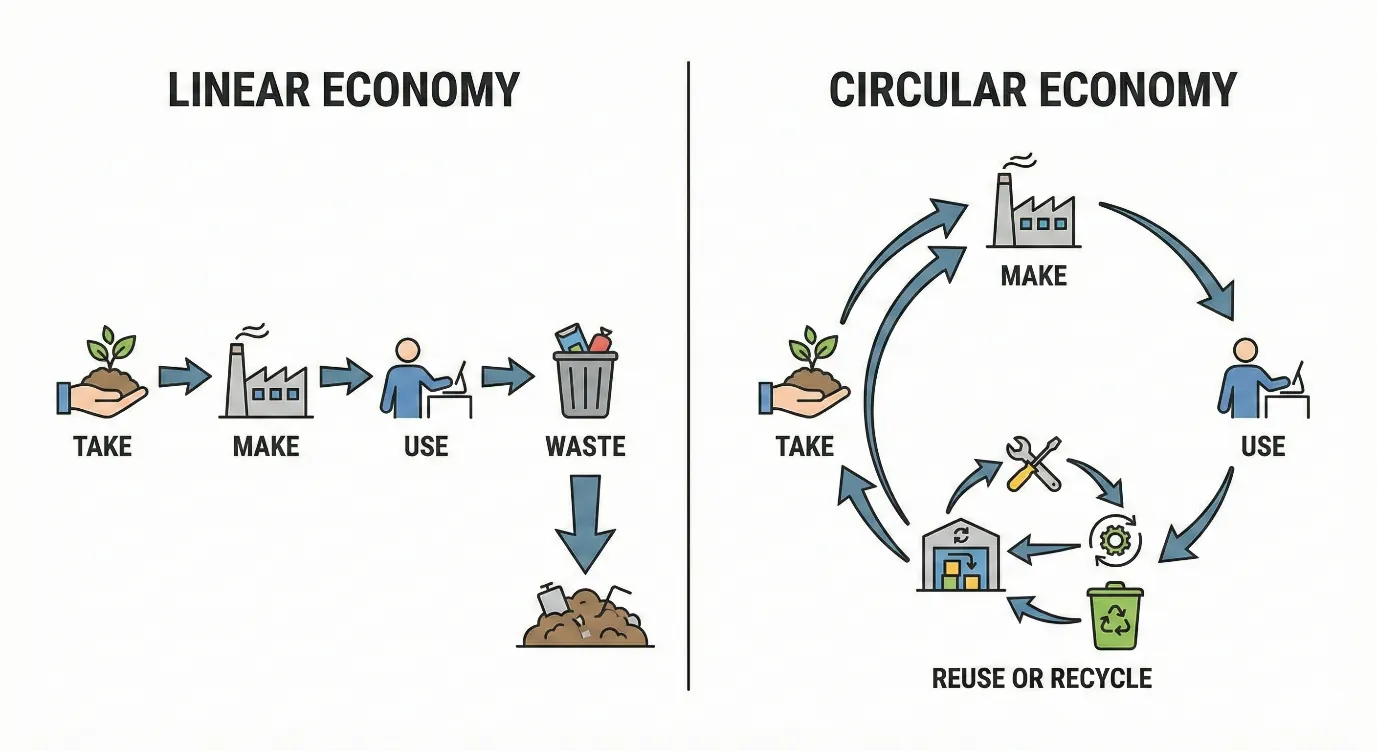
For decades, the global standard has been a Linear Economy.
The Linear Economy (Take => Make => Use => Waste): In this traditional model, we take raw materials from the earth, make them into products, use them until they break or become outdated, and ultimately throw them away as waste. This model relies on planned obsolescence and assumes infinite resources, leading to massive amounts of waste.
The Circular Economy model (Take => Make => Use => Reuse or Recycle) has obvious advantages.
The Right to Repair directive actively forces a shift toward a circular model where resources are kept in circulation for as long as possible. By legally protecting a consumer's ability to repair a device, the product stays in the "Use" phase much longer before it eventually needs to be "Reused" or broken down to "Recycle." Repair is the critical bridge that stops products from prematurely becoming waste.
Key Aspects of the Directive
Mandatory Repair Obligations: Manufacturers must repair, at a reasonable price and within a reasonable timeframe, products that are technically repairable under EU law (European Union, 2024).
Extension of Warranty: The liability period for defects is extended by 12 months following a repair, encouraging consumers to fix rather than replace (European Union, 2024).
Consumer Information & Transparency: A voluntary "European Repair Information Form" will be available to provide transparency on repair conditions, prices, and timeframes (European Union, 2024).
Access to Spare Parts: Manufacturers must ensure independent repairers and consumers have access to spare parts, tools, and repair information at a reasonable price, and they cannot use software or hardware barriers to impede independent repairs (European Union, 2024).
Online Repair Platform: A European online platform will be established to help consumers locate local repair services, sellers of refurbished goods, and community repair initiatives (European Union, 2024).
Promotion of Repairs: Member states are required to take at least one measure to promote repair at the national level, such as repair vouchers, funds, or educational campaigns (European Union, 2024).
Impacted Products
The directive initially covers products with repair requirements under existing EU ecodesign rules. According to Annex II of the Directive (European Union, 2024), this includes:
Household washing machines, dryers, and dishwashers
Refrigerating appliances
Electronic displays (monitors, TVs)
Vacuum cleaners
Servers and data storage products
Mobile phones, cordless phones, and slate tablets
(Note: The scope is expected to expand to more product categories in the future as the European Commission introduces new ecodesign regulations.)
Global Right to Repair Initiatives
The push for repairability is not limited to the EU; several other nations are actively implementing their own legislative frameworks to combat planned obsolescence and reduce electronic waste (Earth.Org, 2025).
Canada: In late 2024, Canada passed Bills C-244 and C-294, amending the national Copyright Act to legally allow consumers and independent repairers to bypass digital locks (Technological Protection Measures) for the purpose of diagnosing, maintaining, or repairing devices (Government of Canada, 2024). Additionally, at the provincial level, Quebec’s Bill 29 introduces strict anti-planned obsolescence rules and mandates that manufacturers disclose the availability of replacement parts and repair services, with enforcement rolling out through 2025 and 2026 (Government of Quebec, 2023).
United States: While there is no overarching federal right-to-repair law for consumer electronics, several states have taken the lead. States like New York, California, Minnesota, and Colorado have passed robust legislation requiring manufacturers to make parts, tools, and documentation available to consumers and independent repair shops for various goods, ranging from smartphones to agricultural equipment (Earth.Org, 2025).
United Kingdom: The UK introduced the Ecodesign for Energy-Related Products and Energy Information Regulations in 2021. This legally requires manufacturers of certain household appliances (like washing machines and refrigerators) to make spare parts available to professional repairers and consumers, though it currently excludes everyday consumer electronics like laptops and smartphones (Earth.Org, 2025).
Australia: Australia's approach has been highly sector-specific so far. In 2022, the government introduced a mandatory data-sharing scheme for the automotive sector, requiring car manufacturers to share service and diagnostic information with independent mechanics (Productivity Commission, 2021). Advocacy groups and the agricultural sector are currently pushing for these rights to be expanded to consumer electronics and farm machinery.
France: Ahead of the broader EU directive, France established Extended Producer Responsibility (EPR) legislation that uses an "eco-tax" to fund repair initiatives. Notably, France introduced a repair bonus fund that allows consumers to claim financial discounts when getting textiles, clothing, and electronics fixed at participating repair shops (Earth.Org, 2025).
Drainage and no Till Farming
Drainage and no till farming are important new “green” technologies for farmers which are so good they have evolved into essential methodologies for desert reclamation along with liquid nano clay and microbial soil additives. I am hopeful that these technologies will achieve much as the scope is huge.
Deserts occupy approximately one‑third of the Earth’s land surface, covering close to 50 million km² of arid and semi‑arid terrain (Institute for Environmental Research and Education 2024). By comparison, the total area used globally for crop production amounts to roughly 1,600 million hectares, or 16 million km², according to the most recent FAOSTAT land‑use data (Food and Agriculture Organization 2025). The scale of this disparity underscores the immense potential of desert greening, whereby even modest improvements in water availability, soil chemistry, or plant productivity could significantly expand global agricultural capacity. Such initiatives, supported by innovations in desalination, mineral recovery from brines, and carbon‑sequestering materials, suggest that deserts may represent one of the largest untapped opportunities for addressing climate mitigation, food security, and ecological restoration on a global scale.
See my paper on DustSaltCollapse, Greening Deserts
Restraining Grazing Animals
By restraining grazing animals to what was originally grassland and re wilding or wooding the land released we can reduce impacts and return vast areas to nature or timber production which must happen more sensibly than it does. Read my paper Grazing Duality
Using CO₂
Carbon dioxide is not just a waste gas, it is a resource we can harness to build a more sustainable future. CO₂ can be captured at source or extracted from brines, then used to manufacture low‑carbon Portland cements and innovative binders such as my own calcium–magnesium TecEco cements. These processes not only reduce emissions but can actively sequester CO₂ into long‑lasting building materials, locking carbon away for generations. I believe I was among the first to advocate for CO₂ sequestration through the creation of carbonate‑based building materials, particularly with TecEco Eco‑Cement, and I remain proud of that early work much of which was published on the TecEco website some 20–25 years ago, well before the global conversation turned toward carbon‑negative materials.
The same mineral‑rich brines used for CO₂ sequestration can also be processed to yield other valuable industrial chemicals, while concurrently producing fresh water with minimal additional treatment. Fresh water is a fundamental requirement for life across the biosphere, and technologies that pair carbon capture with water generation will play a vital role in global sustainability.
CO₂ will become an increasingly valuable commodity, not only for construction but also for food production, particularly lower down the food chain. All life, plant or animal, depends on carbon, and recognising CO₂ as a feedstock rather than a pollutant is essential for our long‑term future. If we move down the food chain, we can produce a lot more carbohydrates and protein for a much lower impact on our planet and significantly reduce land use. See my paper DecouplingFoodfromLand. When mimicking nature we can often do so more efficiently and directly produce foods including CO2.
Decentralising Energy
Deploying Microbial Electrolysis Cells (MEC) with Solid Oxide Fuel Cells (SOFC) across 58,000 waste-water treatment plants would create decentralized energy hubs, each generating clean power and/or reducing greenhouse gas emissions. See my paper MEC_SOFC_Sewage_Power. We can also replace the Born Haber process with ammonia produced from sewage. (Unpublished as yet). By further reducing emissions
Few people realise it yet, but MEC SOFC is easily decentralised. By placing containerised plants nearer building infrastructure in cities as I suggest in my paper TheCityoftheFuture, sewage and energy distribution costs are reduced as is the costs of constant repair of old underground infrastructure. It’s not just the cost of digging up old frequently leaking or broken pipes or replacing them, traffic is held up and people can’t work.
To solve these problems, I propose using box culverts or tunnels under cities perhaps under the middle of dual lane roads or under green verges on the side of roads. Doing so would save significant long term costs if all services including electricity, fibre optics, traffic control, potable water, waste water, storm water, cable TV, Gas etc. were put in underground passages formed using large precast box culverts or by tunnelling machines. Waste water of good quality such as from SOFC that is not made pottable could be used for watering parks, gardens and living walls for extra oxygenation.
Last but not least are. Some of them are already doing a useful job such as and we could help them become more efficient doing what they do with a little genetic engineering.
We must move towards a paradigm that will sustain life in the future. If we get to be good enough at it we may even colonise other planets as Elon Musk seems to want to achieve in his lifetime. Producing a breathable atmosphere on them is yet another challenge!
A Summary of the Drivers for Biosphere Stability
A sustainable civilisation must be built on aligned human needs, coherent incentives, rewarding behaviours, and supportive markets. The only way to achieve that alignment at the scale and speed required is through a circular relationship between:
Needs (the psychological foundation)
Education (the catalyst)
Innovation (the enabler e.g no till farming and salt management)
Utility (the motivational engine in markets)
Internalisation (the economic and institutional anchor)
New Needs and Awareness (the continuity motive
References
Aristotle (1885) The Politics of Aristotle. Translated by B. Jowett. Oxford: Clarendon Press.
Convention on Biological Diversity (CBD) (2010) Strategic Plan for Biodiversity 2011-2020, including Aichi Biodiversity Targets. Montreal: CBD.
Convention on Biological Diversity (CBD) (2020) Global Biodiversity Outlook 5. Montreal: CBD.
Francis, Pope (2015) Laudato Si': On Care for Our Common Home. Vatican City: Libreria Editrice Vaticana.
Gannon, P. et al. (2019) 'Editorial Essay: An update on progress towards Aichi Biodiversity Target 11', Parks, 25(2), pp. 7–18.
Hardin, G. (1968) 'The Tragedy of the Commons', Science, 162(3859), pp. 1243–1248.
Indiana University Blogs, (2019) Primates: Nature’s Grounds Keepers – ScIU.
IPCC, 2022–2023. Sixth Assessment Report (AR6). Geneva: Intergovernmental Panel on Climate Change.
Jehovah Witnesses – Official Website at https://www.jw.org/en/
Kahneman, D., 2011. Thinking, Fast and Slow. New York: Farrar, Straus and Giroux.
Lemieux, C. J. et al. (2022) 'Transformational changes for achieving the Post-2020 Global Biodiversity Framework ecological connectivity goals', FACETS, 7, pp. 1008–1027.
Maslow, A.H., 1943. A theory of human motivation. Psychological Review, 50(4), pp.370–396.
Maslow, A.H., 1954. Motivation and Personality. New York: Harper & Row.
Meehan, M. C. et al. (2020) 'How far have we come? A review of MPA network performance indicators in reaching qualitative elements of Aichi Target 11', Conservation Letters, 13(6), e12746.
Orr, D.W. (1992) Ecological Literacy: Education and the Transition to a Postmodern World. Albany: State University of New York Press.
Ostrom, E. (1990) Governing the Commons: The Evolution of Institutions for Collective Action. Cambridge: Cambridge University Press.
Ostrom, E. (2010) 'Polycentric systems for coping with collective action and global environmental change', Global Environmental Change, 20(4), pp. 550–557.
Pigou, A.C., 1920. The Economics of Welfare. London: Macmillan.
Raworth, K., 2017. Doughnut Economics. London: Random House.
Reed, J. et al. (2024) 'Social justice and inclusive conservation must guide GBF implementation', EcoEvoRxiv. Available at: https://doi.org/10.32942/x2191d
Rockström, J. et al., 2009. A safe operating space for humanity. Nature, 461, pp.472–475.
Schor, J.B., 2010. Plenitude: The New Economics of True Wealth. New York: Penguin.
Stephens, T. (2023) 'The Kunming–Montreal Global Biodiversity Framework', International Legal Materials, 62(5), pp. 868–887.
Stiglitz, J.E., Stern, N. & High-Level Commission on Carbon Prices, 2017. Report of the High‑Level Commission on Carbon Prices. Washington, DC: World Bank.
Tucker, M.E. and Grim, J.A. (eds.) (2014) Ecology and Religion. Washington, D.C.: Island Press.
UNESCO, 2021. Education for Sustainable Development: ESD for 2030 Roadmap. Paris: UNESCO.
White, L. (1967) 'The Historical Roots of Our Ecologic Crisis', Science, 155(3767), pp. 1203–1207.
Cohon, R. (2008) Hume's Moral Philosophy. Oxford: Oxford University Press.
Hume, D. (1739) A Treatise of Human Nature. Edited by L.A. Selby-Bigge (1888). Oxford: Clarendon Press.
MacIntyre, A. (1959) ‘Hume on "is" and "ought"’, The Philosophical Review, 68(4), pp. 451–468.
Sayre-McCord, G. (2023) ‘Hume on Moral Philosophy’, in E.N. Zalta and U. Nodelman (eds) The Stanford Encyclopedia of Philosophy. Fall 2023 edn. Stanford: Stanford University.
Hardin, G. (1968) ‘The Tragedy of the Commons’, Science, 162(3859), pp. 1243–1248.
Lloyd, W.F. (1833) Two Lectures on the Checks to Population. Oxford: Oxford University Press.
Ostrom, E. (1990) Governing the Commons: The Evolution of Institutions for Collective Action. Cambridge: Cambridge University Press.
Almond, R.E.A., Grooten, M. and Petersen, T. (eds) (2020) Living Planet Report 2020: Bending the curve of biodiversity loss. Gland, Switzerland: WWF.
Barbier, E.B. (2023) ‘The Kunming-Montreal Global Biodiversity Framework: Will it work?’, Environmental and Resource Economics, 84(1), pp. 1–5.
CBD - Convention on Biological Diversity (2020) Global Biodiversity Outlook 5. Montreal: Secretariat of the Convention on Biological Diversity.
Obura, D.O., Katerere, Y., Mayet, M., et al. (2021) ‘Integrating biodiversity, climate and development challenges’, Science, 373(6559), pp. 1167–1171.
Kimmerer, R.W. (2013) Braiding Sweetgrass: Indigenous Wisdom, Scientific Knowledge and the Teachings of Plants. Minneapolis: Milkweed Editions. (The definitive text on the Philosophy of Reciprocity).
Rockström, J., Gupta, J., Qin, D., et al. (2023) ‘Safe and just Earth system boundaries’, Nature, 619(7968), pp. 102–111.
Steffen, W., Richardson, K., Rockström, J., et al. (2015) ‘Planetary boundaries: Guiding human development on a changing planet’, Science, 347(6223).
Food and Agriculture Organization 2025, Land statistics 2001–2023: Global, regional and country trends, FAO, viewed 5 March 2026. [philopedia.org]
Institute for Environmental Research and Education 2024, How Much of Earth Is Covered by Desert?, IERE, viewed 5 March 2026. [plato.stanford.edu]
Papers are available as pdfs
at https://gaiaengineering.org/biosphere
©
2026 John Harrison, TecEco.
Licensed under Creative
Commons Attribution-Non Commercial 4.0 International (CC BY-NC 4.0).
You are free to
share, copy, and redistribute this material in any medium or format,
provided you give appropriate credit to the author and do not use
the material for commercial purposes.
Join the Vanguard:
www.tececo.com
©
2026 John Harrison. All rights reserved.
Further documents will be added time & money permitting.